
You’re sleeping eight hours a night, eating vegetables, and hitting the gym three times a week—yet something still feels off. You’re tired, disconnected, or quietly anxious, and you can’t quite explain why. Sound familiar? You might be experiencing an imbalanced
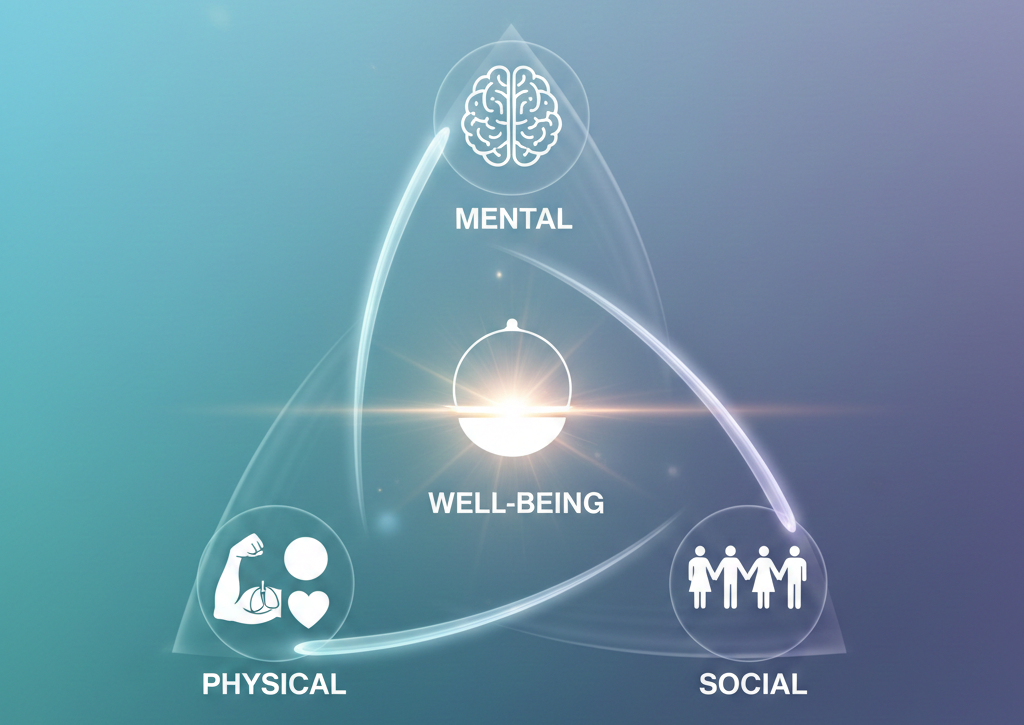
health triangle—a foundational wellness model that says true health isn’t just physical. It depends equally on your mental and social well-being too.
The health triangle has been used in health education for decades. It comes from the World Health Organization’s (WHO) 1948 definition of health as ‘a state of complete physical, mental, and social well-being—not merely the absence of disease.’ Once you understand how the three sides interact, you’ll have a practical framework for diagnosing exactly where your wellness is slipping and what to do about it.
This guide covers everything: the three components, how they apply to women’s health, the iron triangle of health care, and a step-by-step self-assessment you can complete right now.
What Is the Health Triangle?
The health triangle is a model that represents health as an equilateral triangle—three equal sides labeled physical health, mental health, and social health. Each side is as important as the others. When all three are strong and balanced, you thrive. When even one side weakens, the whole structure becomes unstable.
Think of it this way: a triangle is the most structurally stable shape in geometry. Architects use it because pressure on one side distributes across the whole form. Your health works the same way. Stress at work (mental) shows up as tight shoulders and poor sleep (physical), which makes you cancel plans with friends (social)—and suddenly all three sides are crumbling at once.
The model aligns closely with the biopsychosocial framework used in modern medicine, which recognizes that biological, psychological, and social factors all contribute to illness and wellness. It’s not a fringe concept—it’s the backbone of how progressive clinicians and health educators approach whole-person care.
Why Is It Shaped Like a Triangle?
The triangle shape isn’t arbitrary. Each side represents one dimension of health, and no side is optional. Remove any one side and the triangle collapses. This visual metaphor drives home the most important insight of the model: you can’t selectively ignore one dimension of health and expect the others to hold.
The Three Sides of the Health Triangle
Physical Health
Physical health is probably the side most people think about first—and unfortunately, it’s also the side most people reduce to just ‘exercise and diet.’ But it’s much broader than that. Physical health includes regular movement, nutrition, sleep quality, preventive care, and avoiding harmful substances.
The Centers for Disease Control and Prevention (CDC) recommends that adults get at least 150 minutes of moderate-intensity aerobic activity per week, plus two days of muscle-strengthening activity. That’s about 22 minutes a day—manageable for most people, yet nearly 46% of U.S. adults fall short of this goal.
Key physical health habits that are easy to overlook:
- Scheduling an annual physical examination—many serious conditions like hypertension and prediabetes are asymptomatic and only caught through routine screening.
- Prioritizing 7–9 hours of sleep per night (National Institutes of Health/NIH recommendation). Sleep deprivation impairs immune function, memory, and emotional regulation.
- Staying current on preventive screenings: mammograms, Pap smears, blood pressure checks, cholesterol panels, and colonoscopies.
- Managing alcohol intake and avoiding tobacco. Smoking alone accounts for nearly 480,000 deaths per year in the United States (CDC).
Mental Health
Mental health covers emotional well-being, stress management, self-awareness, and the ability to cope with life’s demands. According to the American Psychological Association (APA), 1 in 5 U.S. adults experiences a mental illness in any given year—yet fewer than half receive treatment.
Consider this scenario: Sarah is a 38-year-old nurse. She exercises daily and eats well. But she hasn’t addressed mounting workplace stress for two years. Her anxiety has been affecting her sleep, and she’s started snapping at her kids. Her physical health side looks strong on paper, but her mental health side is buckling—and it’s pulling everything else down with it.
Signs your mental health side needs attention:
- Persistent fatigue that sleep doesn’t fix
- Difficulty concentrating or making decisions
- Withdrawing from people you normally enjoy
- Feeling overwhelmed by routine tasks
- Changes in appetite or sleep lasting more than two weeks
Most anxiety and depression interventions—including therapy, medication, or lifestyle changes—show meaningful improvement within 6 to 12 weeks when applied consistently. The key is starting early, before the mental health side fully collapses and pulls your physical and social health with it.
Social Health
Social health is the most underestimated side of the health triangle. It refers to the quality of your relationships, your sense of belonging, your communication skills, and your engagement with your community. And the data on what happens when it’s neglected is genuinely striking.
A landmark 2015 study by researcher Julianne Holt-Lunstad found that social isolation increases the risk of early death by 26%, and loneliness increases it by 29%—comparable to smoking 15 cigarettes a day. Strong social connections, on the other hand, speed up physical recovery from illness, lower blood pressure, and reduce the risk of cardiovascular disease.
Take the case of a retired teacher, James, who filled his days with exercise after retirement but stopped investing in friendships. Within two years, his cognition declined noticeably. His doctor connected the dots: social disengagement had robbed his brain of the stimulation it needed. His physical health was fine. His social health was not.
Why Balance Matters—and What Happens When It Breaks
Here’s the critical insight most people miss: the three sides of the health triangle aren’t independent. They’re interdependent. Neglecting one side creates a cascading effect that eventually compromises the others.
The Overtraining Athlete
Consider a competitive runner who trains obsessively—six days a week, tracking every macro. Physical health looks exceptional. But he’s sacrificed social events for training, developed rigid eating patterns, and tied his self-worth entirely to his race times. His mental and social health sides have quietly eroded. Eventually, a minor injury triggers depression, and suddenly all three sides are in crisis at once.
The New Mom
A new mother pours everything into her baby’s well-being. She stops seeing friends, skips her own doctor appointments, and tells herself she’ll ‘take a break when things settle down.’ Six months in, she’s physically depleted, socially isolated, and showing signs of postpartum depression. Her triangle has collapsed on all three sides simultaneously—not because she failed, but because she didn’t have a framework to notice the imbalance building.
The Health Triangle and Women’s Health
The health triangle is a universal model, but it has particular relevance for women. Women face unique biological, social, and systemic pressures that affect each side differently across their lifetime.
Women’s Health Across Life Stages
Hormonal changes during the teenage years, pregnancy, perimenopause, and menopause directly affect mental health—mood instability, anxiety, and depression are all more prevalent in women during these transitions. According to the American College of Obstetricians and Gynecologists (ACOG), women are twice as likely as men to experience major depression in their lifetime.
Reproductive health adds another dimension to physical health that requires specific, ongoing attention: prenatal care, well-woman exams, cervical cancer screenings, and hormonal health management. Women who skip these services—often because of cost, time, or access barriers—frequently find conditions caught late that were entirely preventable.
On the social side, many women serve as primary caregivers for both children and aging parents. This ‘sandwich generation’ role often comes at the expense of their own social health. Research consistently shows that women who maintain active social networks and strong support systems report better physical health outcomes and longer lives.
Mental Health Disparities in Women
Women experience higher rates of anxiety, PTSD, and eating disorders compared to men, partly due to societal pressures and partly due to hormonal fluctuations. Yet women are also more likely to seek help—which is a genuine strength worth encouraging. If you’re a woman reading this and your mental health side feels weak right now, that awareness itself is the first step.
Triangle Premier Women’s Health: A Real-World Example
Triangle Premier Women’s Health is an OB-GYN practice serving women in the Triangle region of North Carolina (the Raleigh-Durham-Chapel Hill metro area). It represents the kind of integrated, patient-centered women’s health care that naturally reflects the health triangle model in practice.
Practices like Triangle Premier Women’s Health typically offer well-woman exams, prenatal care, menopause management, and connections to mental health resources and community support programs. This multi-dimensional approach reflects exactly what the health triangle recommends: address physical health through preventive care, support mental health proactively, and connect patients to social resources when needed.
Important note: If you’re considering care at Triangle Premier Women’s Health or any specific practice, contact them directly to verify current services, insurance acceptance, and appointment availability. Provider offerings can change, and this article is informational only.
The Iron Triangle of Health Care
Iron Triangle of Health Care Explained
There’s a second ‘triangle’ you need to know about—this one describes the health care system itself, not individual health. The iron triangle of health care refers to the three competing priorities of any health care system: cost, quality, and access.
The iron triangle works like this: you can optimize any two of the three, but you can’t fully achieve all three simultaneously. It’s a structural constraint, not a failure of willpower or policy.
The Three Iron Triangle Trade-offs
- High quality + broad access = high cost (e.g., comprehensive private insurance with no network restrictions)
- Low cost + high quality = limited access (e.g., a top-tier specialist who only accepts certain insurance plans)
- Low cost + broad access = lower quality (e.g., an overcrowded community clinic with long wait times)
How the Iron Triangle Affects Your Health Triangle
If you can’t afford care (cost barrier), can’t get an appointment (access barrier), or receive inconsistent care (quality issue), your health triangle suffers directly. Unmanaged physical conditions lead to anxiety. Financial stress from medical bills damages mental health. And when illness keeps you homebound, social health takes the hit.
Practical strategies for navigating the iron triangle:
- Use federally qualified health centers (FQHCs)—they offer sliding-scale fees based on income, providing quality care when cost is the main barrier.
- Explore telehealth services for mental health and routine follow-ups. Telehealth significantly improves access for patients in rural areas or those with mobility limitations.
- Maximize your insurance benefits: many plans cover 100% of annual preventive screenings (well-woman exams, blood pressure checks, colonoscopies) with no co-pay when coded correctly.
- Ask your provider about generic medications, patient assistance programs, or 90-day mail-order prescriptions to reduce cost.
How to Assess and Improve Your Own Health Triangle
Self-Assessment: Rate Each Side 1–10
Take two minutes right now. For each side, give yourself an honest score from 1 (critically neglected) to 10 (thriving). Use these prompts:
Physical Health Checklist
- Am I getting 150+ minutes of moderate exercise per week?
- Have I had a physical exam in the last 12 months?
- Am I sleeping 7–9 hours most nights?
- Am I eating a balanced diet with adequate protein, fiber, and micronutrients?
- Am I free from untreated chronic pain or illness?
Mental Health Checklist
- Do I feel generally emotionally stable day-to-day?
- Do I have healthy ways to manage stress (exercise, therapy, journaling, hobbies)?
- Am I free from persistent anxiety, low mood, or emotional numbness?
- Do I feel a sense of meaning or purpose in my daily life?
- If struggling, am I actively seeking support (therapy, medication, peer support)?
Social Health Checklist
- Do I have at least one or two relationships where I feel genuinely supported?
- Am I spending meaningful time with others at least a few times per week?
- Do I feel connected to a community, group, or shared purpose?
- Am I able to communicate my needs clearly in relationships?
- Do I feel a sense of belonging somewhere in my life?
How to Balance the Three Sides of the Health Triangle
Once you’ve scored each side, focus first on your lowest-scoring dimension. Here’s a starting plan:
If Physical Health is your lowest score:
- Schedule a physical exam this week—call your primary care physician or use an online booking tool.
- Add one 20-minute walk per day for the next 30 days. Research shows this single habit reduces all-cause mortality by up to 25%.
- Set a consistent sleep and wake time, even on weekends. Sleep regularity alone improves mood, metabolism, and immune function.
If Mental Health is your lowest score:
- Try 10 minutes of mindfulness or breathing exercises each morning for four weeks—apps like Headspace or Calm make this easy.
- If you scored below 5, consider reaching out to a therapist. The APA’s therapist locator at psychologytoday.com can help you find one in your area.
- Reduce one meaningful stressor this week—delegate a task, set a boundary, or say no to one non-essential obligation.
If Social Health is your lowest score:
- Commit to one meaningful in-person interaction per week—coffee with a friend, a community class, or a volunteer shift.
- Text or call one person you’ve been meaning to reconnect with. Social reconnection starts with one small action.
- Explore a local interest group (meetup.com, community centers, faith organizations) that aligns with something you already love.
When to Seek Professional Help
A score below 4 on any side is a signal worth taking seriously. If you’re experiencing persistent symptoms—physical pain, emotional numbness, or weeks of social isolation—it’s time to consult a healthcare provider. Don’t wait for things to get worse. Early intervention almost always leads to better outcomes.
Frequently Asked Questions (FAQ)
What is the health triangle?
The health triangle is a wellness model that represents health as three interconnected dimensions: physical health, mental health, and social health. All three sides must be balanced for a person to experience complete well-being, as defined by the World Health Organization (WHO).
What are the three components of the health triangle?
The three components are: (1) Physical health—exercise, nutrition, sleep, and preventive care; (2) Mental health—emotional well-being, stress management, and psychological resilience; and (3) Social health—the quality of relationships, communication, and community connection.
Why is the health triangle important?
It provides a simple, actionable framework for understanding why you might feel unwell even when one area of health looks fine. Most people focus exclusively on physical health, neglecting the mental and social dimensions—which account for a significant portion of overall disease burden and quality of life.
How does the health triangle apply to women’s health?
Women face unique hormonal, reproductive, and caregiving challenges that affect all three sides. The American College of Obstetricians and Gynecologists (ACOG) emphasizes that women’s health requires attention to physical care (well-woman exams, prenatal care), mental health (depression and anxiety screening), and social health (support networks and community resources).
What is Triangle Premier Women’s Health?
Triangle Premier Women’s Health is an OB-GYN practice in the Triangle region of North Carolina (Raleigh-Durham-Chapel Hill area). It offers gynecological and obstetric care to women in the region. Always contact them directly to confirm current services and insurance acceptance.
What is the iron triangle in health care?
The iron triangle of health care describes the three competing priorities of any health care system: cost, quality, and access. The concept holds that you can fully optimize only two of the three simultaneously—improving all three at once is structurally constrained. Understanding this helps patients navigate their care options more strategically.
How do I know if my health triangle is out of balance?
Common warning signs include: chronic fatigue that rest doesn’t fix, persistent low mood or anxiety, feeling isolated or disconnected from others, skipping medical appointments, or losing interest in activities you used to enjoy. Use the self-assessment checklist in Section 7 to score each side.
Can the health triangle be used for kids and teenagers?
Yes. The health triangle is taught widely in health education curricula for adolescents. For teens, social health often means peer relationships and school belonging; mental health includes academic stress and identity development; and physical health encompasses sports, nutrition, and puberty-related changes.
How does mental health affect physical health?
The connection is direct and well-documented. Chronic stress elevates cortisol, which suppresses immune function, raises blood pressure, and contributes to cardiovascular disease. Depression is associated with increased inflammation markers. Anxiety disorders frequently manifest as physical symptoms including chest pain, gastrointestinal issues, and chronic headaches.
What’s the difference between the health triangle and the wellness wheel?
The health triangle uses three dimensions; the wellness wheel (or wheel of wellness) typically uses 6–8 dimensions, including intellectual, occupational, environmental, and spiritual wellness. The health triangle is simpler and more accessible; the wellness wheel offers a more granular framework for those who want to go deeper.
How do I improve my social health?
Start small: commit to one meaningful social interaction per week, reach out to someone you’ve been meaning to reconnect with, or join a group activity aligned with your interests. Quality matters more than quantity—one deeply supportive relationship provides more health benefit than a dozen shallow ones.
Where can I get help if my health triangle is severely imbalanced?
For physical health, contact your primary care physician or a federally qualified health center (FQHC) if cost is a barrier. For mental health, use the APA’s therapist finder, contact SAMHSA’s National Helpline (1-800-662-4357), or ask your doctor for a referral. For social health, community centers, faith organizations, and volunteer programs are often excellent starting points.
Key Takeaways
- The health triangle models well-being as three equal, interdependent sides: physical health, mental health, and social health—all three must be maintained for true balance.
- Neglecting any one side creates a domino effect. A mentally depleted person stops exercising. A socially isolated person becomes physically ill. The three sides don’t operate in silos.
- Women face unique health triangle challenges due to hormonal changes, reproductive health needs, and caregiving roles—making comprehensive OB-GYN care and mental health screening especially important.
- The iron triangle of health care (cost, quality, access) is a real constraint. Knowing how it works empowers you to navigate the system smarter—using telehealth, FQHCs, and preventive benefits strategically.
- Your action step right now: score each side of your health triangle from 1–10 and book one appointment or take one concrete action for your lowest-scoring dimension this week.
Your health triangle is never perfectly balanced all the time—and that’s okay. The goal isn’t perfection; it’s awareness and consistent, small improvements across all three sides. Start with your weakest side. Build from there. And don’t hesitate to reach out to a health care provider who can see the full picture of your health—not just one side of the triangle.