
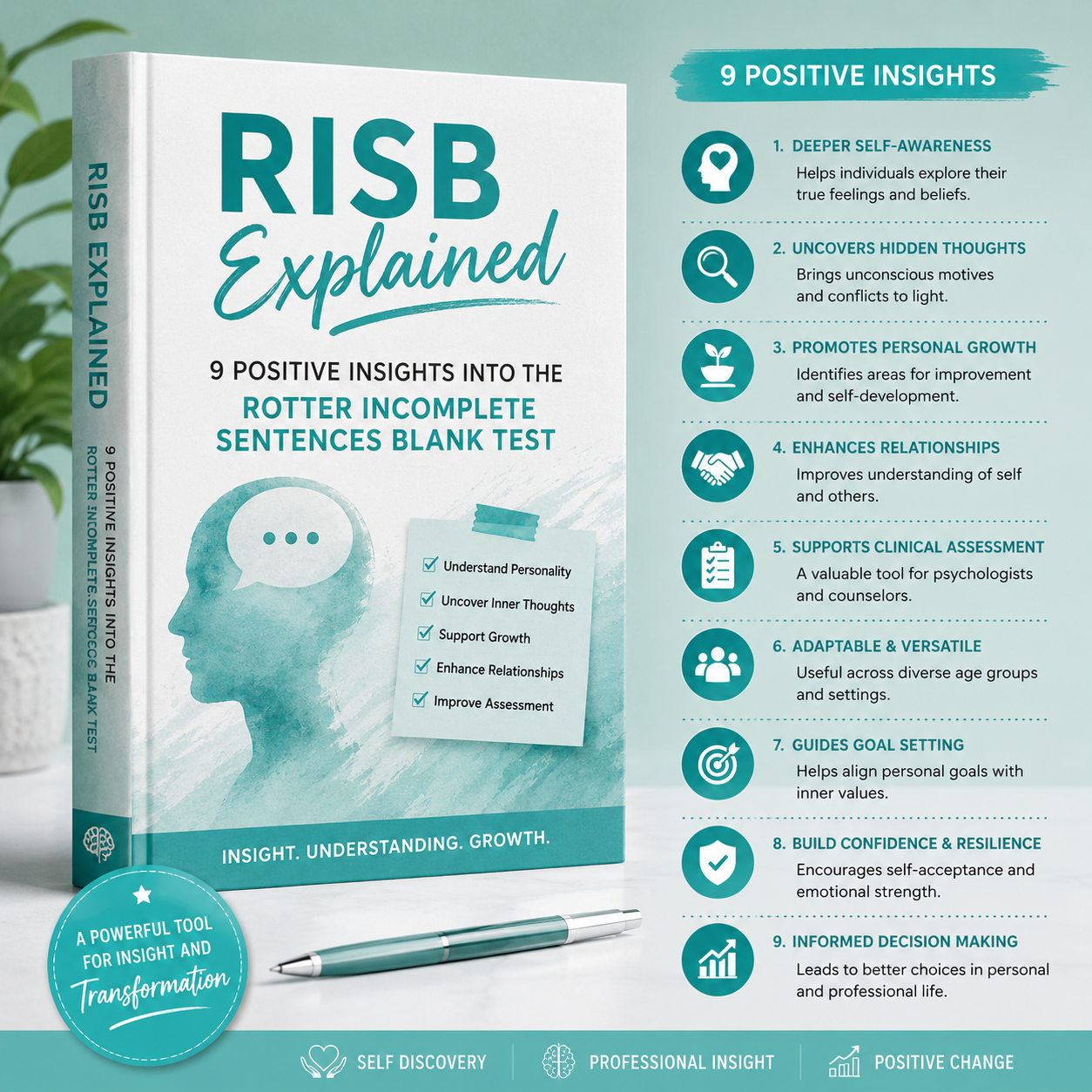
Introduction
In psychological testing, quick yet insightful tools can make a real difference in how professionals understand emotional and social adjustment. One such tool is the Rotter Incomplete Sentences Blank (RISB) — a projective test where individuals complete unfinished sentences.
The RISB is simple in format but rich in what it reveals. It’s widely used in counseling, clinical, and educational settings because it captures aspects of personality and adjustment that people may not openly share in structured interviews.
At Umeed-e-Sukoon, a trusted provider of counseling and therapy services, assessments like RISB can be part of the process to help individuals explore their inner thoughts and emotions in a safe, guided environment.
This article provides a comprehensive guide to RISB: its history, administration, scoring, uses, limitations, and best practices — plus practical tips for counselors and psychologists.
I. Background & Foundations of RISB
Origins and Theoretical Basis
The RISB was created by Julian B. Rotter and his colleagues in the 1950s. It grew from projective techniques in psychology, where open-ended tasks are used to uncover unconscious feelings and conflicts. Unlike the Rorschach inkblot test or Thematic Apperception Test (TAT), RISB is semi-structured and easier to administer.
Rotter believed that the way people complete unfinished sentences reflects their underlying needs, conflicts, and adjustment levels. The theoretical foundation combines psychoanalytic ideas with social learning theory, making RISB both expressive and scientifically grounded.
(Alleydog Glossary)
What is RISB? Definition and Structure
RISB consists of 40 incomplete sentence stems such as:
-
“I regret …”
-
“My father …”
-
“Mostly I …”
Respondents are asked to finish each sentence quickly and honestly. There are three main forms:
-
School Form – for children and adolescents
-
College Form – for young adults in academic settings
-
Adult Form – for general adult populations
The flexibility of RISB makes it valuable in diverse settings, from schools to clinical practices. You can find a digital copy of the original RISB manual on Internet Archive.
Versions and Forms
The test has evolved. The most widely used update is the RISB-2, which includes:
-
Revised norms for modern populations
-
Clearer scoring criteria
-
Expanded use across educational and clinical contexts
For professionals, the official RISB-2 can be accessed through Pearson Assessments.
At Umeed-e-Sukoon, qualified therapists may integrate such updated assessment tools as part of psychological evaluations.
II. Administration & Scoring of RISB
Administering the RISB Test
RISB is quick to administer and requires minimal resources. The typical procedure is:
-
Provide clear, neutral instructions: “Complete each sentence as quickly as possible. There are no right or wrong answers.”
-
Allow 20–40 minutes for completion.
-
Ensure a quiet, private environment.
-
Minimize interference or coaching.
For group administration (e.g., classrooms), instructions should be read aloud with consistent timing.
Umeed-e-Sukoon emphasizes confidentiality and comfort when administering psychological tools. Learn more about their individual therapy process.
Scoring Methodology
Scoring in RISB is semi-objective. Responses are classified into categories and given numeric values:
-
0–1 = Positive / well-adjusted response
-
2–3 = Neutral response
-
4–6 = Conflict / maladjusted response
A total score is calculated. Higher scores suggest greater emotional maladjustment. Some manuals recommend a cutoff of around 135–140 for adolescents as a flag for concern, though exact thresholds vary.
(PubMed Study on RISB Validity)
Blank or omitted answers also carry interpretive weight, as they may signal avoidance or defensiveness.
(Studocu RISB Reporting Guide)
Interpretation and Profile Construction
RISB is not just about numbers. Interpretation requires combining quantitative totals with qualitative analysis:
-
Identify high-scoring items.
-
Look for recurring themes (e.g., family conflict, self-doubt, hostility).
-
Note unusual phrasing or abrupt tone changes.
-
Integrate findings with interviews and case history.
At Umeed-e-Sukoon, professionals may use RISB alongside standardized inventories to form a holistic understanding of clients.
III. Uses, Applications & Benefits of RISB
Clinical and Counseling Applications
RISB is widely used in therapy intake and short-term screening. It helps therapists quickly identify areas of concern, such as anxiety, depression, or interpersonal conflict.
For individuals seeking professional guidance, tools like RISB may be part of Umeed-e-Sukoon’s counseling approach, offered through confidential therapy services.
Educational & Research Applications
In schools and universities, RISB serves as a screening tool for student adjustment issues. Researchers also use it to study personality development and mental health trends.
Its ability to be administered to groups makes RISB cost-effective for large-scale research.
Advantages of Using RISB
-
Efficiency: Short administration time, group-friendly.
-
Flexibility: Combines objective scoring with rich qualitative data.
-
Revealing: Exposes hidden concerns not expressed in interviews.
-
Research-backed: Studies show acceptable interrater reliability when properly scored.
(Wiley Overview of Personality Assessment)
IV. Limitations, Critiques, and Best Practices
Criticisms and Psychometric Concerns
Despite its value, RISB faces critiques:
-
Reliability: Test-retest consistency can be variable.
-
Validity: As a projective test, it measures indirectly.
-
Cultural Bias: Stems may not translate well across languages.
-
Risk of Overinterpretation: Projective responses can be misread.
Mitigating Weaknesses — Best Practices
-
Use RISB alongside structured tests.
-
Ensure scorers are trained and calibrated.
-
Apply cultural sensitivity when interpreting.
-
Clearly note limitations in reports.
V. Practical Tips & Guidelines for Practitioners
Before Administering RISB
-
Select the appropriate form (school, college, adult).
-
Read the manual’s administration script.
-
Obtain informed consent.
During the Test
-
Maintain neutrality.
-
Remind respondents to answer quickly.
-
Avoid commenting on answers.
After Administration
-
Score per manual.
-
Analyze themes qualitatively.
-
Integrate findings into a narrative report.
If you are a counselor looking to strengthen your assessment toolkit, consider exploring Umeed-e-Sukoon’s therapy and assessment services.
VI. Case Example (Hypothetical)
Client A: 18-year-old freshman.
Responses:
-
“Mostly I …” → “hide what I feel”
-
“I regret …” → “letting my dad down”
-
“My mother …” → “is proud but distant”
Scoring & Interpretation:
-
Elevated total score suggests adjustment issues.
-
Themes: secrecy, family pressure, self-esteem struggles.
-
Recommendation: further standardized testing + short-term counseling.
VII. Research, Norms, and the RISB-2
The RISB-2 is the current version, offering updated norms and scoring. Studies confirm convergent validity with self- and informant-reports of emotional issues. Cut scores near 135–140 are often flagged, but interpretation depends on age, culture, and context.
VIII. Digital Use and Modern Adaptations
Today, many assessments are moving online. For RISB:
-
Use validated platforms that preserve item wording.
-
Ensure data confidentiality.
-
Pilot digital formats before full rollout.
Official digital options are available via Pearson’s Q-global platform.
At Umeed-e-Sukoon, teletherapy services can integrate assessments responsibly into online sessions.
IX. Conclusion
RISB is an enduring, versatile tool that balances structure and freedom. It’s quick to administer, insightful in interpretation, and adaptable across settings.
When used alongside structured measures, and interpreted with training and care, RISB provides valuable glimpses into personal adjustment and emotional well-being.
For those seeking guidance, Umeed-e-Sukoon’s therapy services ensure tools like RISB are used ethically, compassionately, and effectively.
FAQs
1. What does RISB stand for?
RISB = Rotter Incomplete Sentences Blank.
2. How long does RISB take?
Usually 20–40 minutes.
3. Is RISB reliable and valid?
Yes, with proper scoring and when used alongside other tools.
4. Can RISB be used online?
Yes, through validated platforms.
5. What is the cutoff score?
Around 135–140 in adolescent samples, but varies by context.
6. Can responses be faked?
Yes, socially desirable answers are possible — which is why multiple assessments are better.
7. Where is RISB most useful?
Schools, counseling centers, clinics, and research.
8. How is RISB different from other projective tests?
It’s shorter, semi-objective, and easier to administer than tools like the Rorschach or TAT.
Reviews
There are no reviews yet.