✨ Introduction
Mental health care is evolving—and fast. At the center of this transformation is artificial intelligence. From AI-powered chatbots to advanced emotional tracking systems, mental health technology is reshaping how people access support (Bendig, Erb, Schulze-Thuesing, & Baumeister, 2019).
What once required a therapist’s office can now happen through a smartphone. This shift has made digital mental health tools more accessible than ever. People are turning to AI therapy for convenience, affordability, and privacy (Inkster, Sarda, & Subramanian, 2018).
But as AI becomes more integrated into our emotional lives, a deeper question arises: How is it changing us?
The conversation around AI and mental health often highlights its benefits. Yet, research suggests there are also subtle risks. This includes the hidden psychological effects of talking to AI, which can influence emotional behavior and social interaction over time (Fang, Peng, & Zhang, 2025).

🧩 Understanding AI and Mental Health
What Is AI in Mental Health?
Artificial intelligence in mental health refers to systems designed to simulate human interaction and provide emotional support. These tools form the foundation of modern AI therapy, offering structured conversations and coping strategies (Fitzpatrick, Darcy, & Vierhile, 2017).
They include:
- Chatbots that mimic therapeutic dialogue
- Mood-tracking apps
- Virtual companions
This growing field is part of a larger shift toward digital mental health, where technology makes emotional support more accessible (Laranjo et al., 2018).
Why AI Is Gaining Popularity in Mental Health Care
The rise of online therapy trends 2026 reflects a shift toward digital-first care.
Key reasons include:
- Accessibility in underserved areas (Li, Peng, & Rheu, 2024)
- Lower costs compared to traditional therapy
- Reduced stigma
- 24/7 availability
Current Applications and Technologies
Modern mental health technology relies on:
- Natural Language Processing (NLP)
- Machine learning
- Emotion recognition systems
These advancements power what researchers call chatbot psychology, which explores how humans emotionally interact with AI systems (Shu, Lai, & He, 2026).

🌟 Benefits of AI and Mental Health Support
Increased Accessibility to Mental Health Resources
AI has made mental health support more inclusive.
For individuals without access to therapists, digital mental health tools offer a practical alternative. They remove barriers like distance, cost, and long wait times (Inkster et al., 2018).
At the same time, combining AI tools with trusted human-centered platforms can provide deeper support. Platforms like Umeed-e-Sukoon (https://umeedesukoon.com/) focus on emotional well-being, awareness, and guidance—helping individuals access reliable mental health resources beyond automated systems.
This balanced approach strengthens outcomes by blending AI therapy with real human insight (Bendig et al., 2019).

Cost-Effective Alternatives to Traditional Therapy
One of the biggest advantages of AI therapy is affordability.
Many AI tools are free or low-cost, making mental health support more accessible to a wider population (Fitzpatrick et al., 2017).
Personalized and Data-Driven Insights
AI systems adapt to user behavior.
They can:
- Identify emotional patterns
- Suggest personalized coping strategies
- Offer behavior-based recommendations
This makes mental health technology more dynamic and user-focused (Laranjo et al., 2018).
Immediate Emotional Support and Crisis Assistance
AI provides instant responses.
Users can:
- Access calming techniques
- Talk through stress in real time
- Receive guided exercises
While helpful, AI should always complement—not replace—professional care (Li et al., 2024).
⚠️ Risks and Limitations of AI in Mental Health
Lack of Human Empathy and Emotional Depth
AI can simulate empathy but does not truly feel emotions.
This limitation affects AI and human behavior, especially in complex emotional situations where human understanding is essential (Shu et al., 2026).
Privacy and Data Security Concerns
Mental health data is highly sensitive.
Users should be cautious about:
- Data storage practices
- Privacy policies
- Platform credibility
These concerns are part of broader AI mental health risks (Fang et al., 2025).
Over-Reliance on AI Tools
Convenience can lead to dependency.
Some users may:
- Prefer AI over real conversations
- Avoid seeking professional help
- Develop emotional reliance
Maintaining balance is essential (Chu, Min, & Park, 2025).
🧠 Hidden Psychological Effects of Talking to AI
The psychological effects of AI often develop gradually and can go unnoticed (Fang et al., 2025).
Emotional Attachment to AI Systems
A major concern is emotional attachment to AI.
Users may begin to:
- Form bonds with AI
- Treat it as a confidant
- Prefer it over human interaction
This reflects core principles of chatbot psychology (Shu et al., 2026).
Altered Communication Patterns and Social Skills
AI conversations are predictable and non-judgmental.
Over time, this can influence real-life interactions, subtly shaping AI and human behavior (Chu et al., 2025).
Reinforcement of Cognitive Biases
AI often validates user input.
This can:
- Reinforce negative thinking
- Limit exposure to new perspectives
- Reduce critical thinking (Fang et al., 2025).
The Illusion of Being Understood
AI creates a strong sense of emotional validation.
However, this is based on algorithms—not genuine understanding (Shu et al., 2026).
Dependency and Escapism
One of the most overlooked AI mental health risks is dependency.
Some users may rely on AI as an emotional escape, avoiding real-life challenges. These patterns highlight the deeper, hidden psychological effects of talking to AI (Yuan, Zhao, & Liu, 2025).
🔍 Ethical Considerations in AI and Mental Health
Responsibility of Developers and Organizations
Developers must design ethical systems that:
- Ensure user safety
- Maintain transparency
- Avoid misleading emotional realism (Fang et al., 2025).
Informed User Consent and Awareness
Users should understand:
- They are interacting with AI
- How their data is used
- The limitations of AI tools (Li et al., 2024).
Balancing Innovation with Human Care
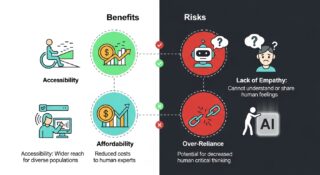
Understanding the virtual therapist pros and cons is key:
Pros: Accessibility, affordability, convenience
Cons: Lack of emotional depth, risk of dependency
Combining AI with human support is essential. Trusted platforms like Umeed-e-Sukoon (https://umeedesukoon.com/) provide guidance and awareness, helping users balance AI therapy with real human connection (Inkster et al., 2018).
Real-Life Example:
Rehan, a college student, began chatting with an AI companion daily for emotional support. Over time, he started sharing personal thoughts with the AI more than with his friends. While the AI provided consistent validation, Rehan noticed a decline in face-to-face interactions. Through counseling offered by Umeed-e-Sukoon, he learned strategies to balance digital support with human connections, mitigating potential emotional dependency (Shu, Lai, & He, 2026; Fang, Peng, & Zhang, 2025).
🛠️ Best Practices for Using AI in Mental Health
Combining AI with Professional Therapy
AI works best as a supplement.
Use it for:
- Daily emotional check-ins
- Support between therapy sessions
- Habit tracking
At the same time, integrating human-led support platforms such as Umeed-e-Sukoon (https://umeedesukoon.com/) helps maintain emotional balance and prevent over-reliance on AI systems (Bendig et al., 2019).
AI has made mental health support more inclusive.
For individuals without access to therapists, digital mental health tools offer a practical alternative. They remove barriers like distance, cost, and long wait times.
However, combining AI tools with trusted human-led platforms can provide even better outcomes. For example, platforms like Umeed-e-Sukoon—a dedicated mental health support initiative—offer guidance, awareness, and access to emotional well-being resources alongside digital solutions. You can explore their services here:
👉 https://umeedesukoon.com/
This hybrid approach—blending AI therapy with human-centered care—ensures that users receive both convenience and genuine emotional support.
Setting Healthy Boundaries with AI Tools
To avoid negative psychological effects of AI:
- Limit usage
- Maintain real-world relationships
- Avoid emotional dependency (Chu et al., 2025).
Choosing Reliable and Ethical AI Platforms
Select tools that are:
- Research-backed
- Transparent
- Secure (Li et al., 2024).
🔮 The Future of AI and Mental Health
Advancements in Emotional Intelligence in AI
AI is becoming more advanced in simulating emotional responses.
Future systems may better understand context and nuance, improving interaction quality (Shu et al., 2026).
Integration with Healthcare Systems
AI is expected to play a larger role in healthcare by:
- Supporting therapists
- Monitoring patient progress
- Enhancing treatment plans
These developments align with evolving online therapy trends 2026 (Li et al., 2024).
Addressing the Hidden Psychological Effects of Talking to AI
Future research will focus on:
- Ethical safeguards
- User education
- Encouraging real-world interaction (Fang et al., 2025).
❓ Frequently Asked Questions (FAQs)
Is AI therapy effective?
Yes, AI therapy can help with mild to moderate mental health concerns. However, it should complement—not replace—professional care (Fitzpatrick et al., 2017).
What are the psychological effects of AI on users?
They include emotional attachment, dependency, and changes in communication patterns—key aspects of the psychological effects of AI (Fang et al., 2025).
What are the virtual therapist pros and cons?
Pros: Accessibility, affordability, instant support
Cons: Limited empathy, dependency risks (Shu et al., 2026).
Are there risks in using digital mental health tools?
Yes. Common AI mental health risks include privacy concerns and emotional reliance (Chu et al., 2025).
How can I safely use AI for mental health?
Use it in moderation, combine it with human interaction, and rely on trusted platforms like Umeed-e-Sukoon (https://umeedesukoon.com/) for balanced support (Inkster et al., 2018).
🧾 Conclusion
Artificial intelligence is transforming mental health care. Through AI therapy and modern mental health technology, support is now more accessible than ever (Bendig et al., 2019).
But this progress comes with responsibility.
The hidden psychological effects of talking to AI—including emotional attachment, dependency, and behavioral changes—remind us that technology should enhance, not replace, human connection (Fang et al., 2025).
The future of AI and mental health lies in balance.
Use AI wisely. Stay connected to real people. And combine digital tools with trusted human-centered platforms like Umeed-e-Sukoon (https://umeedesukoon.com/) to ensure truly meaningful mental well-being.
📚 References
Bendig, E., Erb, B., Schulze-Thuesing, L., & Baumeister, H. (2019). The next generation: Chatbots in clinical psychology and psychotherapy to foster mental health—A scoping review. JMIR Mental Health, 6(2), e12121. https://doi.org/10.2196/12121
Fitzpatrick, K. K., Darcy, A., & Vierhile, M. (2017). Delivering cognitive behavior therapy to young adults with symptoms of depression and anxiety using a fully automated conversational agent (Woebot): A randomized controlled trial. JMIR Mental Health, 4(2), e19. https://doi.org/10.2196/mental.7785
Inkster, B., Sarda, S., & Subramanian, V. (2018). An empathy-driven, conversational artificial intelligence agent (Wysa) for digital mental well-being: Real-world data evaluation. JMIR mHealth and uHealth, 6(11), e12106. https://doi.org/10.2196/12106
Laranjo, L., Dunn, A. G., Tong, H. L., Kocaballi, A. B., Chen, J., Bashir, R., … & Lau, A. Y. S. (2018). Conversational agents in healthcare: A systematic review. Journal of the American Medical Informatics Association, 25(9), 1248–1258. https://doi.org/10.1093/jamia/ocy072
Li, L., Peng, W., & Rheu, M. (2024). Factors predicting the adoption of AI chatbots for mental health support. Telemedicine and e-Health. Advance online publication. https://doi.org/10.1089/tmj.2023.0313
Shu, C., Lai, K., & He, L. (2026). Human-AI attachment: Understanding emotional bonding with artificial intelligence systems. Frontiers in Psychology. Advance online publication.
Fang, C. M., Peng, W., & Zhang, M. (2025). How AI and human behaviors shape psychosocial effects of chatbot use. arXiv Preprint. https://arxiv.org/abs/2503.17473
Chu, M. D., Min, J., & Park, S. (2025). Illusions of intimacy: Emotional attachment and risks in human-AI relationships. arXiv Preprint. https://arxiv.org/abs/2505.11649
Yuan, Y., Zhao, X., & Liu, Q. (2025). Mental health impacts of AI companions: A longitudinal study. arXiv Preprint. https://arxiv.org/abs/2509.22505
На данном ресурсе легко найти обилие нужной материалов.
Тут содержатся публикации и рекомендации на любой интерес.
Читатель сможете изучить и общую базу, также узкопрофильные данные.
Наш ресурс пригодится профессионалам в различной обучении.
https://tltrock.ru/material/2026-05-27-krossovki-dolceandgabbana-i-gendernye-granitsy-uniseks-ili-razdelenie.html
Также на портале постоянно добавляются актуальные статьи.
Рекомендуем подробно просмотреть доступную здесь коллекцию.
В итоге, данный ресурс считается полезным источником знаний.
Осознанный гемблинг — это стратегия к азартным сессиям, основанный на самоограничении и понимании рисков.
Она подразумевает добровольное лимитирование продолжительности и бюджета на игру.
Каждый участник обязан предварительно устанавливать лимиты ставок и неукоснительно их соблюдать.
https://nashipesni.ru/pub/2026-07-09-tramp-gotov-vvesti-bespoletnuyu-zonu-nad-ukrainoy-pri-narushenii-rossiey-mirnykh-dogovoryonnostey/
Ответственная игра — это принцип к казино, основанный на самоограничении и понимании последствий.
Эта концепция предполагает добровольное лимитирование времени и расходов на процесс.
Любой участник должен заранее определять пределы потерь и строго их придерживаться.
https://wolgograd.ru/column/2726-mobilnyy-opyt-v-randx-casino-kak-igrat-so-smartfona/
Разумное отношение к азарту — это подход к казино, базирующийся на самоограничении и понимании рисков.
Она подразумевает осознанное ограничение продолжительности и расходов на процесс.
Любой участник обязан предварительно устанавливать лимиты ставок и строго их соблюдать.
https://rosotels.ru/detail/2026-07-10-otvetstvennaya-igra-v-randx-casino-instrumenty-samokontrolya-i-podderzhka-igrokov.htm
Si estas buscas donde contratar jetskis en este lugar, hay multiples posibilidades atractivas tanto en el area sur como en diversas zonas como la Costa Adeje y la Playa de las Americas. Lograras localizar alquiler moto de agua Tenerife sur con valores convenientes y salidas como jet bike safari o aqua safari que combinan adrenalina pura y vistas maravillosos. Para propuestas mas concretas, tambien existe la oportunidad de alquilar motos de agua en Tenerife Los Gigantes o disfrutar deportes acuaticos en Puerto Colon. Para mas referencias sobre disponibilidades y valores, te sugiero visitar jet bike safari .
Tambien, Tenerife presenta propuestas para todos los niveles, desde principiantes hasta expertos, con negocios como Jet Hub Tenerife y Adrenalina Jet que realizan salidas en jets de agua y jet ski safaris en areas como Costa Adeje. Si te interesa una actividad enriquecedora y garantizada, evalua las excursiones motos de agua Tenerife sur o en diferentes puntos, y no ignores que gestionar con tiempo siempre ayuda, principalmente en los periodos de mayor afluencia. Por si lo precisas, el telefono +34 612 345 678 puede ser practico para dudas rapidas.
Осознанный гемблинг — это принцип к азартным сессиям, базирующийся на контроле и понимании последствий.
Эта концепция подразумевает добровольное лимитирование времени и бюджета на игру.
Каждый игрок обязан заранее устанавливать лимиты ставок и неукоснительно их придерживаться.
https://rosotels.ru/detail/2026-07-03-listya-uzhe-v-dyrkakh-kak-spasti-kapustu-ot-krestotsvetnoy-bloshki.htm
Prudent betting is a set of practices that ensure gambling stays a form of entertainment instead of a source of financial strain.
Key aspects include establishing individual boundaries on duration and wagers, as well as recognising the indicators of problematic behaviour.
Ultimately, responsible gambling encourages informed choices and supports players to maintain balance over their playing activities.
https://eurasia-log.ru/blog/2026-06-22-tragicheskiy-intsident-na-urale-shkolnik-mototsiklist-sbil-inomarku/
Осознанный гемблинг — это принцип к азартным сессиям, основанный на контроле и понимании рисков.
Она подразумевает добровольное лимитирование продолжительности и расходов на процесс.
Каждый участник обязан предварительно устанавливать пределы потерь и строго их придерживаться.
https://protivbed.ru/full-article/strategii-igry-v-aviator-nauchis-razbivat-bank-1961/
Ответственная игра — это принцип к игровым развлечениям, основанный на самоограничении и осознании рисков.
Эта концепция включает осознанное ограничение времени и денег на игру.
Каждый игрок должен заранее определять пределы потерь и неукоснительно их придерживаться.
https://studiogp.ru/pub/61-voronezhskie-prostory-okhvacheny-plamenem-ognennyy-intsident-u-dorogi.html
Mindful gaming is a collection of principles that ensure betting remains a form of entertainment rather than a means of financial strain.
Key aspects include establishing individual limits on duration and wagers, as well as recognising the indicators of harmful behaviour.
Ultimately, this approach encourages conscious choices and helps users to keep control over their gaming activities.
https://wolgograd.ru/column/2446-pvo-otrazilo-zalp-iz-pyati-britanskikh-raket-storm-shadow-tsifry-i-kontekst/
Разумное отношение к азарту — это подход к игровым развлечениям, базирующийся на контроле и осознании рисков.
Эта концепция предполагает добровольное лимитирование продолжительности и расходов на процесс.
Любой игрок должен предварительно определять пределы ставок и строго их соблюдать.
https://s8.superlooks.ru/MtXsTbZLxSBk/
Осознанный гемблинг — это стратегия к азартным сессиям, основанный на контроле и понимании рисков.
Эта концепция предполагает добровольное лимитирование продолжительности и денег на игру.
Любой участник обязан предварительно устанавливать пределы потерь и неукоснительно их соблюдать.
https://sibitforum.ru/digital/2026-06-28-psikhologiya-igry-v-sloty-kak-kontrolirovat-ludomaniyu.html
Разумное отношение к азарту — это подход к азартным сессиям, основанный на контроле и осознании последствий.
Она подразумевает добровольное ограничение времени и бюджета на игру.
Любой участник должен предварительно устанавливать пределы ставок и неукоснительно их придерживаться.
https://businessman.fashionvipclub.ru/aMdpTfbQjBCn/
Разумное отношение к азарту — это подход к азартным сессиям, основанный на самоограничении и понимании рисков.
Она предполагает добровольное ограничение времени и денег на игру.
Любой участник обязан заранее определять пределы ставок и строго их соблюдать.
https://healthcoach.myfashionacademy.ru/JA8u5Q1tZWj2/
Разумное отношение к азарту — это подход к казино, основанный на контроле и понимании последствий.
Эта концепция предполагает добровольное лимитирование продолжительности и расходов на процесс.
Любой участник обязан предварительно определять пределы потерь и строго их придерживаться.
https://ledtechexpo.ru/news/2026-06-15-tambovskiy-sud-predostavil-vdove-veterana-vov-edinovremennuyu-yubileynuyu-vyplatu.html
Ответственная игра — это стратегия к игровым развлечениям, основанный на контроле и понимании последствий.
Эта концепция подразумевает осознанное лимитирование времени и бюджета на процесс.
Любой игрок обязан заранее определять лимиты ставок и строго их придерживаться.
https://bm1.irkpress.ru/QzZFoIRXK2aP/
Концепция разумного риска — это регламент, направленный на обеспечение дисциплины по отношению к своими решениями и предотвращение потенциальных проблем.
https://sparktv.net/read-blog/44480
На этом ресурсе есть возможность обнаружить массу нужной информации.
https://e-transavto.ru/read/iskusstvo-ukhoda-za-delikatnymi-tkanyami-515/
На этом ресурсе можно отыскать массу полезной материалов.
https://liveforsport.ru/full-text/1695-zashchitnik-baltiki-iz-kalmykii-voshyol-v-elitu-rossiyskogo-futbola.html
Networked titles deliver users the excellent chance to bond and unwind with others everywhere.
https://urls.mvmedia.ru/7ErwUfe1kuN1/
На этом портале есть возможность обнаружить массу ценной материалов.
https://www.elephantjournal.com/profile/nader76346/
Здесь ресурсе можно отыскать много нужной информации.
https://zoom.nl/profiel/lepodium
Digital entertainment offer gamers the enjoyable method to connect and discover with friends globally.
https://bokhokhanhhung.com/tin-tuc/spisok-rand-x-zerkalo-luchshikh-ofitsialnykh-klubov-s/
На этом веб-сайте можно получить важную информацию.
https://online-festival.ru/detail/1404-pauza-v-rossiysko-amerikanskikh-peregovorakh-ot-irana-do-kharaktera-lidera.html